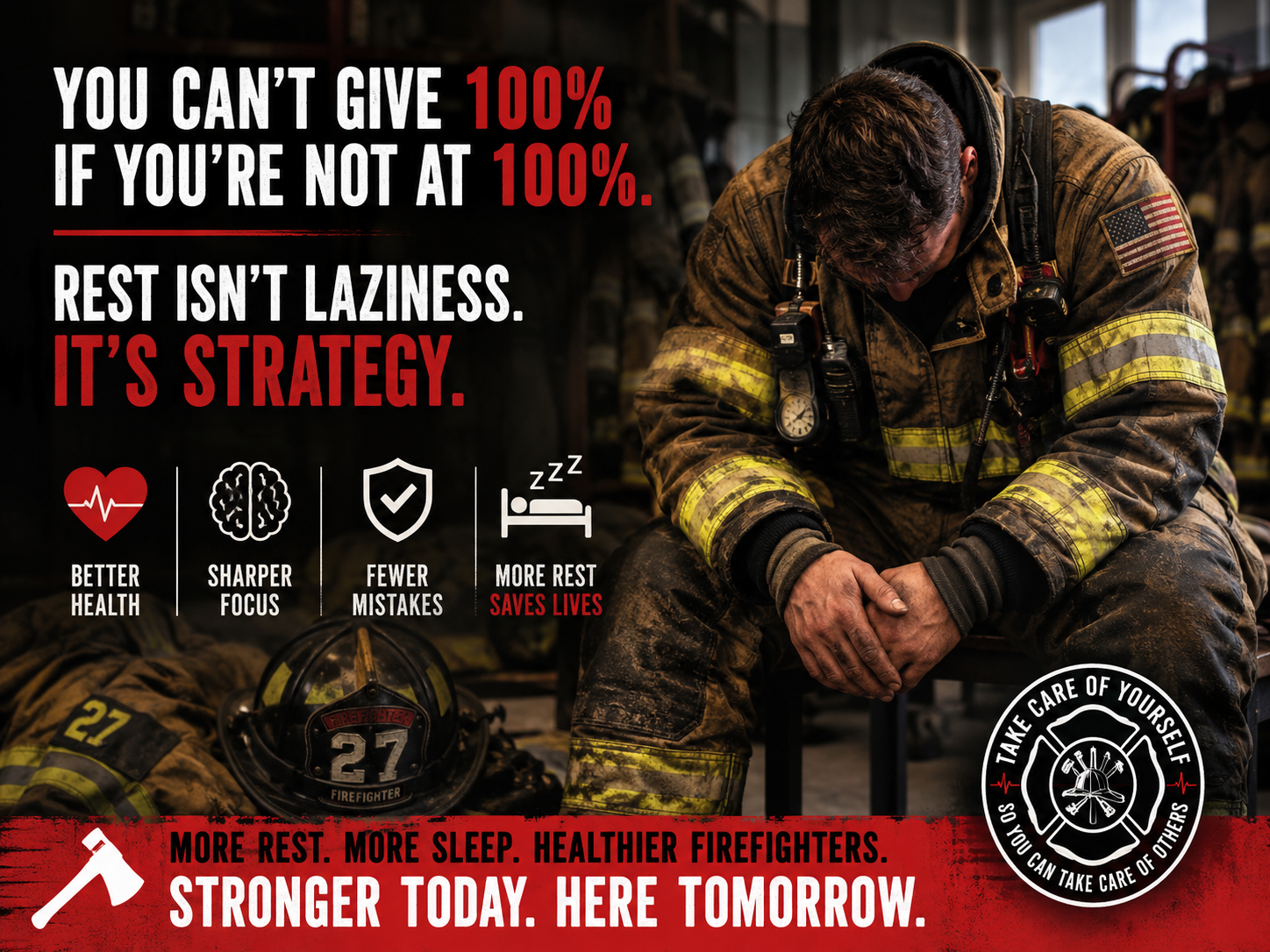
There was a picture I saw recently with a quote from Abraham Lincoln that really hit home for me:
“Give me six hours to chop down a tree and I’ll spend the first four sharpening the axe.”
Then underneath it said something even more important:
“You can’t give 100% if you’re not at 100%. Rest isn’t laziness. It’s strategy.”
As a firefighter, that message feels more real now than ever before.
Across the country fire departments are running more calls than they ever have before. EMS volume is exploding. Staffing is tight. Budgets are stretched. Politics slow things down. Meanwhile, firefighters are being expected to do more with less every single year.
And the truth is, our bodies are paying the price.
We are seeing more firefighters having medical emergencies on and off duty. Yes, line of duty deaths from fires and traumatic incidents still happen, but many firefighters are now dying from heart attacks, strokes, stress related illnesses, exhaustion, and long term wear and tear on the body. Research from organizations like the IAFC and firefighter health studies continues to show that sleep deprivation, chronic fatigue, and stress increase the risk of cardiovascular disease, poor mental health, injuries, and even cancer in firefighters.
The fire service has always prided itself on toughness. We train hard. We work hard. We stay busy. Somewhere along the way, being exhausted almost became a badge of honor.
But firefighters are not robots.
At some point, we have to stop acting like running nonstop with no recovery is sustainable. We cannot preach health and wellness while also expecting firefighters to function at a high level with little sleep, constant interruptions, and nonstop stress.
Here is the simple truth:
More rest equals better performance.
More sleep equals healthier firefighters.
More recovery equals fewer mistakes, fewer injuries, and probably fewer heart attacks.
Studies have shown that firefighters dealing with poor sleep have worse cognitive performance, slower reaction times, increased stress levels, and higher risks of injury and cardiovascular disease. That should concern every department in America.
What I am saying is not complicated.
If we make training mandatory, why can’t recovery matter too?
If reports have to be finished at 3 a.m no matter whatwhy can’t departments also prioritize policies that allow firefighters opportunities to rest…not when possible but REQUIRED.
Sleep should not be viewed as laziness. It should be viewed as preparation.
The culture has to evolve. The military studies recovery. Athletes study recovery. CEOs talk about recovery. But in the fire service, we sometimes glorify burnout.
That mindset has to change.
You want healthier firefighters? Start with sleep.
You want fewer heart problems? Start with sleep.
You want better mental health? Start with sleep.
Sometimes the biggest solutions are also the simplest ones.
We do not need firefighters running themselves into the ground just to prove they are tough. We need firefighters healthy enough to make it through an entire career and still enjoy life after retirement.
Rest is not weakness.
Rest is survival.