I never thought I would be writing a blog post about spiders. In fact, I really didn’t want to write this one because I hate spiders with a passion! But after what happened to me one morning, I had to figure out what was going on.
Apparently, Georgia has some new residents, and they don’t seem interested in paying rent!
I’m talking about the Joro spider, and if you live in Georgia, you’ve probably seen these things hanging around your yard, porch, or driveway.
My Morning Turned Into a Boxing Match
Picture this. It’s early in the morning, and I’m getting ready to leave for work and tis dark outside. Everything seems normal until I walk outside.
That’s when all hell breaks loose.
Spiderwebs were EVERYWHERE!
I’m talking about webs on every corner. As I walked toward my cars, I started running into them. Then I stepped between my vehicles, and that’s when the real fight began.
I got hit from one side, then the other. I was stumbling around, trying to get these webs off me. I felt like I was in a boxing match, except my opponent had eight legs and a serious home field advantage lol!
And trust me, I wasn’t laughing.
I didn’t know where the spiders were, what was crawling on me, or whether I was about to get bitten. All I knew was that I needed to get out of there!
Once I survived that morning adventure, I decided to do some research.
What Exactly Is a Joro Spider?
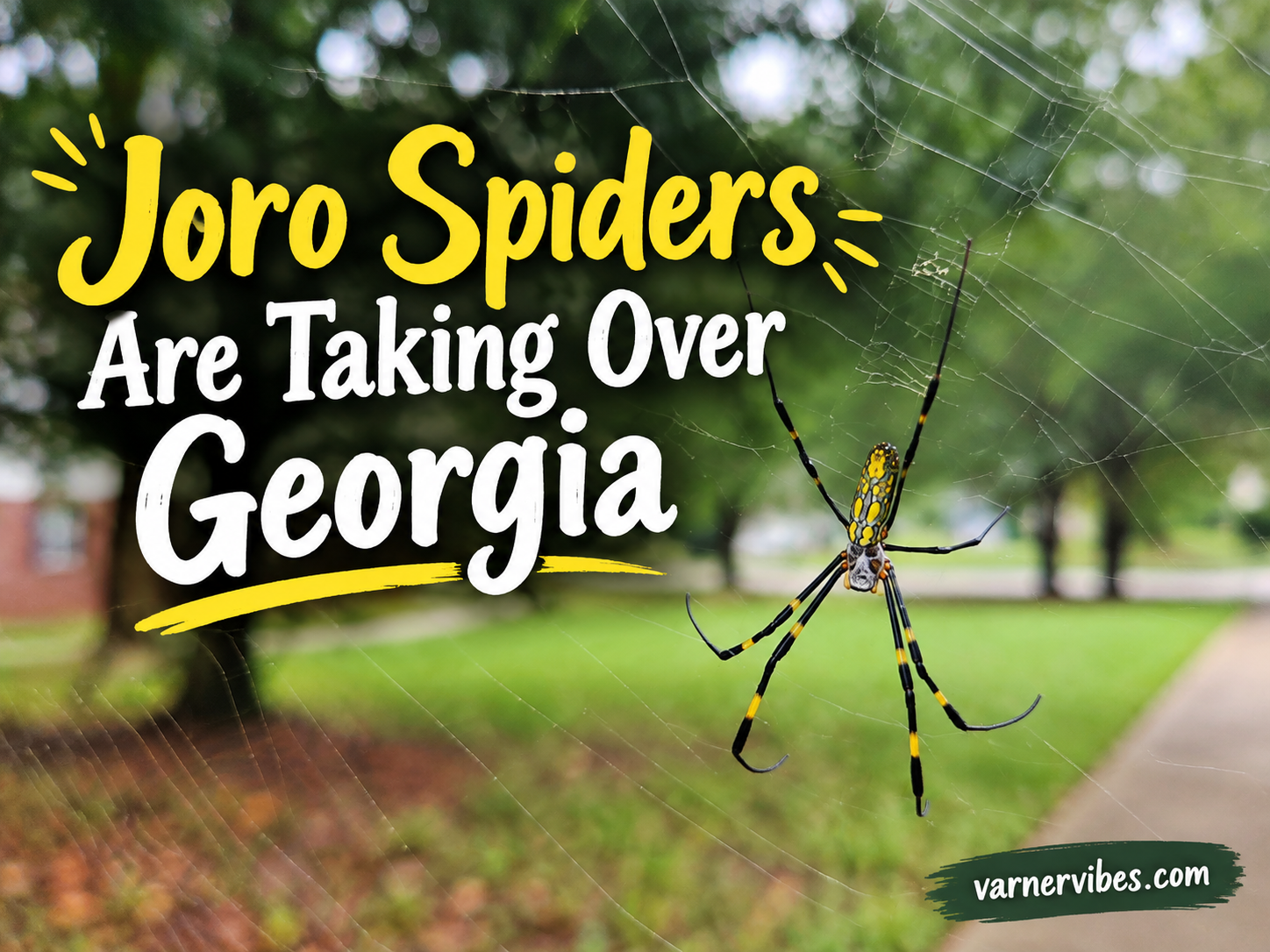
The Joro spider (Trichonephila clavata) is an invasive spider from East Asia, including Japan, China, and Korea.
It was first reported in Georgia around 2013 or 2014 and has since spread across parts of the southeastern United States.
Female Joro spiders can have leg spans of several inches. They have bright yellow, black, and blue markings, making them hard to miss.
And those massive golden colored webs? They’re surprisingly strong!
Why Are There So Many in Georgia?
Joro spiders have become common for several reasons.
- They reproduce quickly. Females can lay hundreds of eggs in one egg sac.
- They travel through the air. Young spiders release silk that helps them ride the wind, a process called ballooning.
- Georgia’s climate suits them. They can handle cooler temperatures better than some other spiders.
- They eat insects. Their webs catch flies, mosquitoes, and other flying bugs.
Scientists are still studying how they affect native wildlife.
Will Joro Spiders Disappear During Winter?
Here’s what I find interesting. It feels like these spiders are getting worse as the weather gets cooler!
But there’s an explanation.
Joro spiders grow throughout the summer and become much larger and easier to spot during the fall.
As freezing weather arrives, adult spiders typically die. However, their eggs survive the winter and hatch in spring.
So, unfortunately…this isn’t a permanent goodbye.
The Million Dollar Question….. Do Joro Spiders Bite?
YES! Joro spiders can bite humans!
And that was probably the most interesting thing I learned.
My stepdad always told me…. “If it can eat, it can bite.” I’ve believed that ever since.
Joro spiders are venomous, but their venom is not considered medically dangerous to most people. Their bites are rare because they usually avoid humans.
Their fangs may struggle to break human skin. If a bite happens, symptoms are generally mild, such as brief pain, redness, or swelling.
They’re not considered a serious threat like black widows or brown recluses.
Still, have you SEEN these things?
I don’t care how harmless scientists say they are. A giant spider hanging between my cars at five in the morning is enough to ruin my day!
Georgia, We Have a Spider Problem!
Maybe I’ve been living under a rock, but I don’t remember seeing these spiders growing up.
Now they’re everywhere!
I understand they help control insects, and I respect their place in nature. But I would appreciate it if they stayed out of my yard and driveway.
Until then, I’ll be checking every corner before leaving for work.
Because after that morning boxing match, I’m officially 0-1 against the Joro spiders lol!