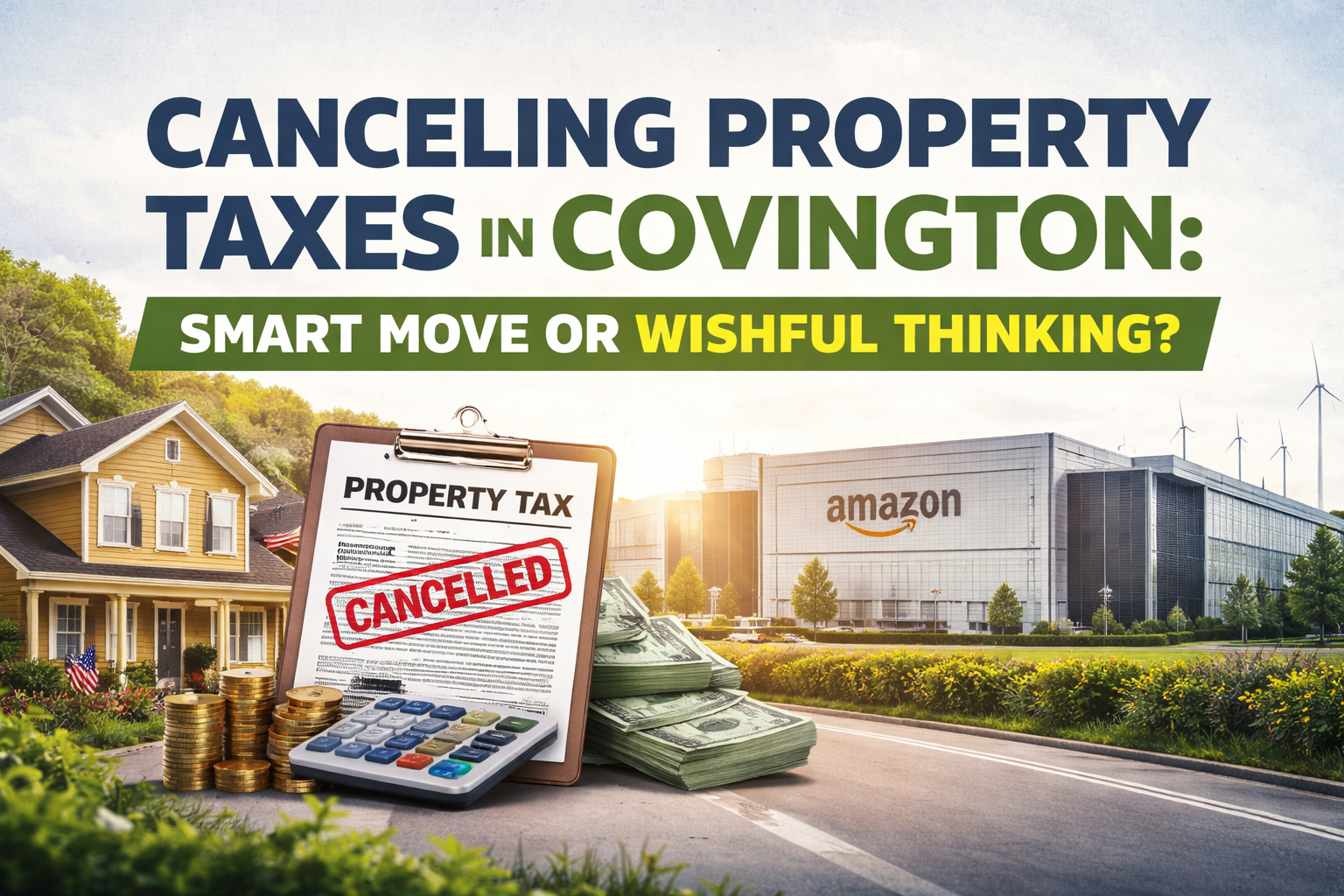
I’ll be honest when I first saw the headline about Covington’s mayor proposing to eliminate property taxes, it stopped me in my tracks. Not because it sounded crazy, but because it sounded bold. And right now, bold ideas around taxes are everywhere.
We’ve been hearing a lot lately about cutting taxes out altogether. Georgia’s governor has openly talked about eliminating the state income tax, and even on the national stage, Donald Trump has floated similar ideas. So seeing something like this pop up locally? That’s encouraging. It feels like the conversation is finally moving from talk to action.
The idea itself is simple on paper, use revenue from large data centers to fund city services instead of relying on homeowners’ property taxes. If you own a home, that’s hard not to like. Property taxes keep going up, even when wages don’t. For many families, especially seniors or middle class homeowners, those taxes feel like a permanent bill you never finish paying.
From that perspective, this proposal feels like a win. It shifts the burden away from residents and onto massive corporations that can afford it. Data centers generate huge revenue, use relatively few public services compared to their footprint, and are already changing the economic landscape across Georgia. Using that money to stabilize or eliminate local property taxes makes sense in theory.
But here’s where I put the brakes on my own excitement.
Relying heavily on one revenue source is risky. Data centers aren’t going anywhere tomorrow, but markets change, tax incentives change, and political priorities change. If a city builds its entire budget around one industry and that revenue dips, residents could feel the pain fast either through service cuts or sudden tax increases down the road.
There’s also the question of fairness and long term sustainability. Data centers require massive infrastructure support power grids, water, roads, emergency services. If those costs rise faster than expected, does the math still work? Or do homeowners eventually get pulled back into the equation…hmm?
Another concern is that “eliminating” property taxes rarely means eliminating them forever. It usually starts with exemptions or freezes, which can be reversed by future leadership. That doesn’t make the idea bad, but it does mean residents should stay realistic. This isn’t a magic switch. It’s a policy choice that requires discipline, transparency, and long-term planning.
That said, I don’t think this idea should be dismissed as fantasy either.
If anything, it might be a sign of a larger shift. People are fed up with feeling taxed from every direction. They want governments to think differently, to innovate, and to stop defaulting to “raise taxes” as the solution. Using economic development to offset the burden on everyday residents is exactly the kind of thinking people have been asking for.
So is this the start of a new trend? Maybe. Or maybe it’s a test case that shows what works and what doesn’t for other cities watching closely.
Either way, it caught my eye. Not because it’s perfect, but because it shows someone is finally asking the question: Is there a better way to fund local government without squeezing homeowners? That’s a conversation worth having!!!